Dimboola

Dimboola
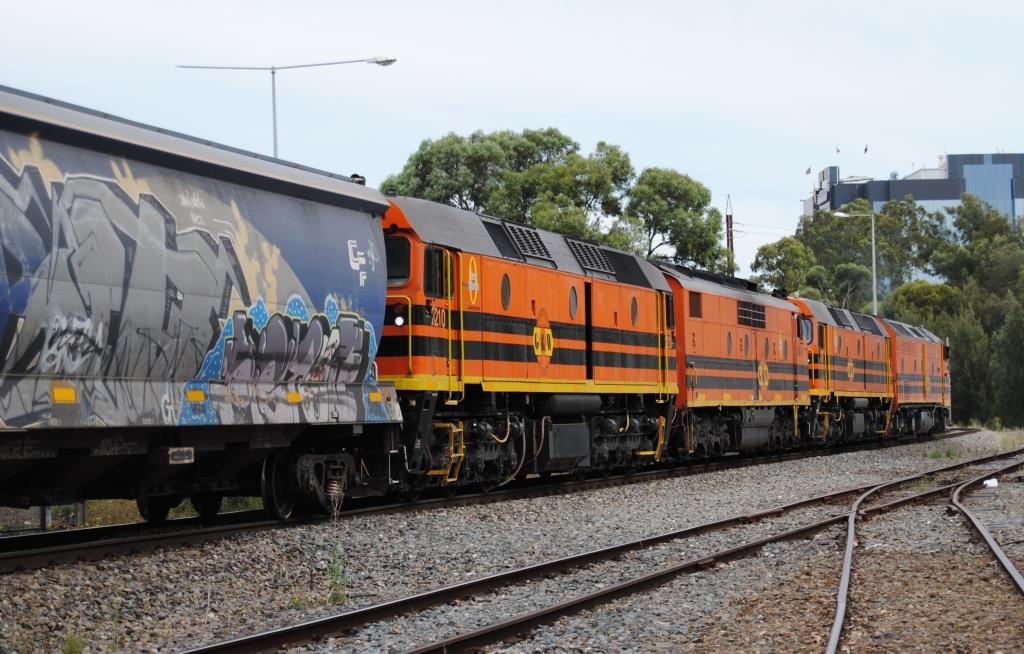
Dimboola station. This great photo was taken by my son Craig

Saturday, 5 March 2016

Postcard from the USA

For something completely different. My daughter, on her travels in the USA took a bus tour to the Grand Canyon. Along the way, they stopped at the Grand Canyon Railroad at Williams for lunch.
There, ex Spokane, Portland and Seattle, 2-8-2 Mikado O-3 class 539 is "stuffed and mounted" or on display, non operational, with some items of rolling stock.


Sunday, 14 February 2016

Strath Hobbies HB/SH/AHWY hopper kit

Sunday, having ridden from Goolwa to Victor Harbour, and while waiting for the pickup transport, called in at Endoftheline Hobbies. While looking around, noticed a sample of an up-coming kit for the SAR SH/AHWY ballast hoppers.
Originally built for the South Australian railways as a ballast hoppers, they were also fitted with a roof during the grain season for grain cartage.

They began life in SAR grey, before Australian National repainted in Green and Gold: now classified as AHWY. (Four units were transferred to Tasmania as QN/HQ class). At the end of AN, these wagons were transferred to ARTC, and refurbished with automatic door operating systems: repainted into yellow: classified as AHWX wagons.

Sunday, 20 December 2015

South Australian Silo Verticals

After a reminder about posting drawings for South Australian concrete vertical silos: its time! These structures are spaced about every forty miles along from Tailem Bend to the Victorian border ( about the distance a horse and cart could travel in a day, from farm to station/silo; before the days when farmers had trucks or contracted freight companies to haul their grain).
There are two basic types, the twin vertical: similar to the Victorian silos, and a four cell plus design, that is, the smallest, like at Keith, is a four cell, or South Australian Bulk Handling added extra twin cell to increase capacity. Same design, just more cells. (The silos at Roseworthy are different).

Sorry, slightly off center, but the edge of the scan is the edge of the cell,
The height of the cell from ground to top is 325mm, the total height is 464mm and the cells are 110mm in diameter (same as PVC piping).
Bunnings sell PVC pipe by the meter, and if you are careful you can get a near straight cut. At least one end will be square cut. My model is not (will post photos soon). I found it was easier to screw to pipes together with some self drilling screws, top and bottoms, but make a wooden block to hold them in shape.

Coonalpyn has ten cells, plus two steel bins.
https://upload.wikimedia.org/wikipedia/commons/0/09/Coonalpyn_silos.JPG 

Tintinara has 8 celss.

http://www.johnnyspages.com/classic_pictures_menu_files/classic_present_day_pics_files/south_line_stations/wolseley_line_stations/tintinara_4_wayne_31-08-2010.jpg 

Drawings for two cell silos. (I have left these a larger file size).


PS If anyone is modelling QR, they have silos that almost the same design as the SA ones. The first link is for Dalby, and the second, Wandoan.

http://queenslandplaces.com.au/sites/queenslandplaces.com.au/files/imagecache/watermarked/exhibits/slides/UQ160806.jpg
https://en.wikipedia.org/wiki/Wandoan#/media/File:Gain_silos,_Wandoan,_2014.JPG

Sunday, 18 October 2015

Norfolk Pine crafting

Horsham Station is dominated by a large Norfolk Pine tree at the eastern end of the station, in a garden area. Having searched the model tree world, nothing came close, so began the saga of producing the tree.
I started with a pine dowel trunk, originally carved for an S scale pine tree, so this a cut to an approximate size and further carved. Next come the branches. A quick study of prototype trees showed they have branches coming out from the trunk with a few smaller branches at the ends, on which the 'leaves' are formed. These were made from twisted wire, and lots of them!
Thin wires being twisted for branches.

Branches being added.
These were then planted into the trunk, after a many a hole was drilled. Next step, was to cover all the branches with No More Gaps. The trunk and branches were then brush painted with a matt brown paint, then very lighting over sprayed with silver.

Tree covered in No More Gaps
Tree in place, in the garden, also been modeled.

The adding of the 'leaves' was the next problem. The tree stayed leaf less for some time, as the leaves are thick needle like, only on the top of the end of the branches. Finally I decided to spray glue the outer parts of the branches, then use static fibers for the leaves. This worked quite well, but I thought I had stuffed it, when the whole tree turned green. Luck had it, most of them were excess and a good blow removed them. I think I will need to add another layer of longer green fibers. to bulk up its appearance. Does not quite look like the real thing, but it is getting there: really, I just want a model tree that looks like a Norfolk Pine. One thing I had not realised was that the real tree is actually a twin: that is, it has two trunks from about a third of the way up.

Saturday, 17 October 2015

CGAY to AHAY grain hoppers

On the 23 September 2015, all the Chicago Freight Car CGAY grain hoppers were transferred in ownership to G&W. They are to recoded to AHAY. These wagons have been used by G&W, on lease since they were built in 2001, and have operated in many South Australia, but also through into Victoria. (81 of these M100 series units were built. There is also the CGDY, M92 series hoppers: 42 built; with a lower handling capacity, operating in the eastern states.).
Nine of these wagons were also built for Freight Australia in 2001, coded VHKY 1151-59.


More information: http://www.anicassociates.com/files/maxis_brochure.pdf

Hopper recoded AHAY 900Y. CF markings removed, but remains in original livery.

Saturday, 3 October 2015

Ontrack 80 class

Ontrack models have announced that their next locomotive will be the NSW class 80. This loco is already available from Austrains, but it was their first RTR locomotive and the tooling must be close to 20 years old, and does not have any of the detail that is expected today. Generally I am not into the NSW locos, but as the 80's ran into Horsham during the 2012-13 period, so I might be interested in a QUBE and Greentrains livery.

Ontracks
According to information available, all the design work has been complete and tooling has commenced. 13 liveries, over five different car bodies. (Both QUBE and Greentrains livery is on their list, so it is highly likely that two will join the Horsham layout fleet).


Monday, 14 September 2015

Its a class 22 time

On a recent Facebook comment, Auscision, indicated the possibility of a ARG/G&W class 22, in a second run of their 422 class locomotives. These have always been slotted for the second run, as I have asked several times over the years. In fact, the first engineering sample received from the factory, was a class 22: well the first four rebuilds anyway. These four locomotives (all named) were built for the Alice to Darwin line construction, and are all the same. Any 22 class from then on, have not had the same rebuild, and in fact, none of them are the same, all having slight differences.

Auscision Artwork.
Any models will be probably, be the first four only; but this does not mean they have not ventured out. Usually, they are used on shuttle trains around Adelaide.

Auscision engineering sample.

2202 Katherine at Port Adelaide.

2212 and a mate, head up towards Mount Barker Junction, on a light engine movement.

Usual position for a class 22 (2210 at the rear): that is making up motive power on grain working.