Dimboola

Dimboola
Dimboola station. This great photo was taken by my son Craig

Saturday, 25 February 2012

SCT ABSY wagons

More SCT wagons in model form have arrived. My pack of ABSY in SCT red, white and black have arrived. But what is this, they are all smooth roof numbers. Where are the corrugated roof versions? (Have been informed that will have to wait till the next run for the corrugated roof versions.)
One of the numbers in the pack is ABSY 2800A. That's the one on the right.
Three ABSY units and a PBGY upfront.
There is a bit of a height difference between the two models. the Railmotor model of the PBGY might be a bit high. Can just notice in the distance.

Here is a photo of one of the test shots, with a corrugated roof.

Friday, 10 February 2012

Reach Stackers 2

Purchased Kibri 11752 Container trailer loader. (Currently in yellow, but has been released in the past in red). This can also be used as a top grab reach stacker. It is interesting, that when TNT used reach stackers at their Islington terminal in the 1980's, they used the arms to lift from the bottom of the container.

I have modified the kit slightly, by moving the driving cab from the side of the vehicle to the centre and raised it a bit. Many of the safety rails have been left off . This gives an appearance of the type of reach stacker that I am looking for, and I also did not attach the trailer lifting arms. I also added a driver.
This model could also be used for OO scale 1/76. The cab might need to be enlarged, and the brackets that hold the containers need to be cut off and replaced with new ones glued to the sides, and the arms need to be extended.

 Kibri unt against a C-Rail intermodal OO scale container.

Saturday, 4 February 2012

Something new

Sunday, started cold and wet for a historic unloading of the new CSR locomotives at Port Adelaide. Two (CSR 005 and CSR 003) had already landed on Saturday evening. The first Pandaroo landed in the morning was CSR 004 after two hours. Next CSR 006 after an hour, then CSR 001 followed by CSR 002, at half hour each.
CSR004

CSR004

CSR006

CSR002

 The blue plastic sheet is coated with anti-rust, while the outer white/green sheet is for water proofing. The locos took two days to load in the China, each having it bogie cradles welded to the hold deck then secured down for the voyage. On arrival the weld is broken.
According to the young Chinese manager from CSR watching the unloading, the remaining four units have yet to be built, though they have all the components. also along for the three months is the design engineer.
Unfortunately we did not get to see the special Pandaroo sheet covering CSR 002. (The first to be loaded in China). As can be seen the wind was ripping the plastic covering off as the emerged from the ship's hold, as in the first photo. It will be over three months before the remaining four units arrive, two will be off-loaded at Newcastle, and the last two, again at Port Adelaide.

Saturday, 28 January 2012

Stawell

The next two stations after Horsham are Murtoa; (another major grain receiving station), and Stawell. Stawell was/is a gold mining town, and this is reflected in the impressive brick station that use to serve the town. Associated with the main building is a small brick goods shed. There use to be two impressive signal boxes and had a nice set of operating road crossing gates: now all gone.
The rather unloved brick goods shed at Stawell.  
I have a nice set of photos taken in the 1980's on slides. Will post later.

Wednesday, 4 January 2012

Tale of a mill

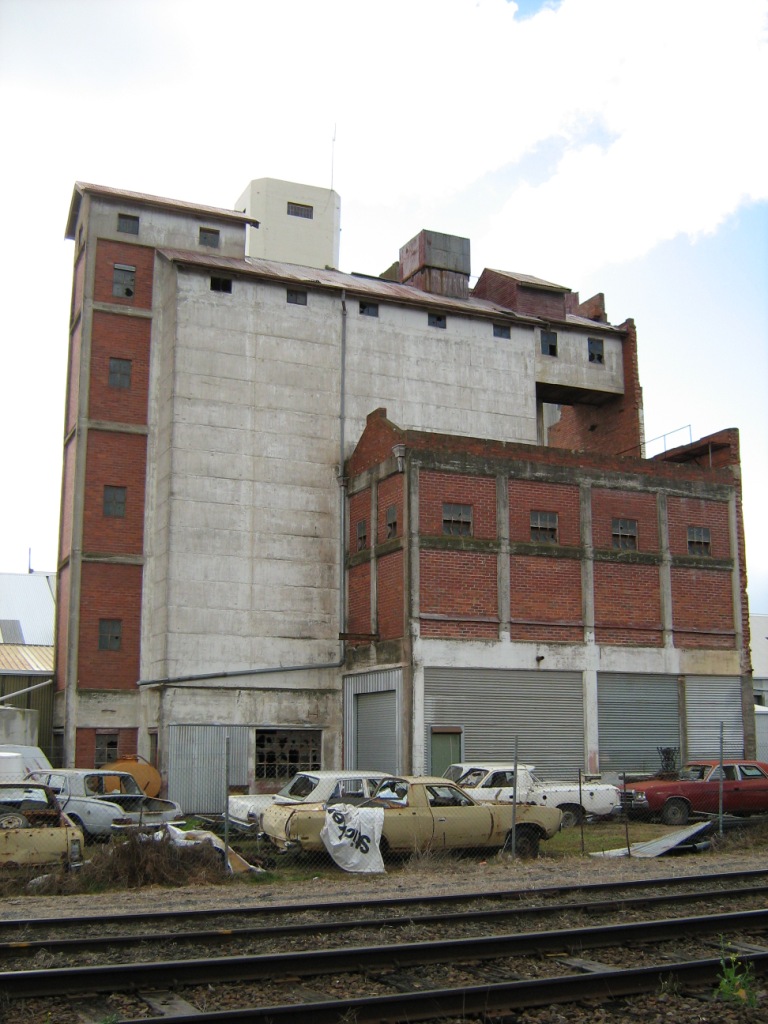
There was more to Horsham station than just the railway infrastructure. At the western end of the yard are the remains of the Noske Flour mill complex. Part of this is currently now used as a furniture factory. The mill, built in 1873, was purchased by T.J Noske, in 1895, when the Union mill collapsed financially;  founding the flour-milling firm of Noske Bros. Ptv. Ltd. in Horsham, then establishing mills at Nhill, Charlton and Murray Bridge (S.A .).
In 1907 a new brick mill was built to replace the old galvanized iron building. This building was added to, by the building a another story when the mill machinery was upgraded during the 1920's. This part of the mill has since been demolished. Photographic evidence shows the building standing in 1985 but gone by the early 1990's.
In 1919 a 125000 bushel silo was constructed, and it was probably around this time the mill was extended with a concrete and brick addition, which survives today.

 
Broad gauge track leading into mill complex.
125000 bushel silo north of the mill.
From a railway point of view, siding three and four connected  to serve the mill. The track remains in the road and into the mill complex. This was later altered, with siding three been lengthened to run down the side of the mill, with siding four leading to the mill,  now being crossed the new siding number six and oil siding number seven.
Mill remains from the rail side.

Friday, 30 December 2011

Tale of a goods shed

The goods shed at Horsham is one of a few long sheds in Victoria. The only unmodified long shed is at Port Fairy. No rail line there, as it was closed in 1977.

These were a Victorian Railways standard 20 ft wide design, timber framed and clad in corrugated iron, constructed throughout Victoria during the period of rapid expansion of the railway system, between 1876 and 1907.
At Horsham, the shed is also not original, as it was burnt down in 1890. As the Melbourne Telegraph newspaper report of July 16 stated. "The railway goods-sheds at Horsham were destroyed by fire last night. A quantity of gunpowder stored there exploded, and none of the contents were saved."

 The new shed has been modified over time with an addition at the western end to allow drive in fork lift access, while an office was built in the eastern end.
When building models from a guesstimate drawing, one is always going to have problems. The width of the model was taken from a card model, when translated to paper, some how became wider. So when I read that these shed were 20' wide I checked and found that the model was 25' wide. This actually related to an extra line of stumps underneath. Their distance apart came from a goods platform drawing.
Main structure of shed completed

I then had to decide if to leave it or to modify back to 20' wide.

 Starting with the addition section, I removed this from the main building and made the cuts to reduce its width. Next was to start on the main structure.
Walls removed and floor ready to be cut down. I will have to build a new eastern wall, as I think the windows were wrong any way.

Sunday, 18 December 2011

Horsham station 2

Further history to the station. The station was extensively repaired in 1939.


The plan call for the construction of  new additions under the existing buildings and  the sinking of 125 new piles driven 29 feet onto the soil under the existing foundation, with all the walls being set on new re-enforced rail foundations. This was because the unstable nature of the earth had allowed the building to sink.
The whole layout was changed to isolated the main block from the goods shed and other building.
The booking, parcels and station master's  offices all under went extensive alterations, and  the men's waiting room was shifted to the middle of the building, plus new general waiting room and new women's waiting room; while the refreshment room was refitted to an improved standard.
The existing main entrance was closed and moved to the new booking office entrance built so it was no longer required to enter via the platform. The cantilever veranda was estended to go around the sides of the building. This brought the station in line with the railway's standard construction. It was estimated that about 16 Horsham workers were  kept occupied for six months on the job. Approximately £1800 was spent in labour costs alone. 
The plans, followed on from the new truck yards. The work was completed in 1940 including painting of the building.